Writers and other creative folks aren’t immune to the races of the Joneses of the world.
Logging into social media shows authors a rose-colored view of what a writer’s life looks like, but — just as everything else on social media isn’t quite what it seems — the writerly life isn’t as perfect as some would have you believe.
I know it’s easy to compare yourself to situations and circumstances that couldn’t be further from your reality, to push yourself to emulate the lifestyles of other writers because you believe you should, that it’s the right thing to do, that doing so is the path to your success.
But this is pure hogwash. Just as our regular lives are beautifully varied, so, too, are the lives of writers.
Every successful writer I know has built their own habits and processes, independent of — even in spite of — what others were doing. After all, if there was no room for creativity in thinking and problem solving, we’d all be flat-Earthers.1 Most people alive today would likely not know who Galileo was, just sayin.’
So if you find yourself trapped in a cycle of comparison dreaming of the day when you finally “make it,” let this post be a reminder: Don’t write yourself ragged.
Are you surprised that “procrastinate” is my first piece of advice for this week2? Me, too, in all honesty. But when I came upon The Positive Side Of Procrastination by Ann Gomez for Publication Coach, I was reminded of a conversation I had with my daughter just last week after I asked her to clean up her room.
She was bored. Existentially bored in the way only five-year-old children can be, apparently, walking through the house and moaning about needing something to do. “Clean your room” was apparently the wrong activity, but beyond that simple suggestion, I staunchly refused to solve her boredom problem. She needed to solve that problem for herself using her creative faculties.
For the creative mind, procrastinating with purpose and letting yourself become bored could be the thing you need to solve whatever problem you’re having in your writing, whether it’s an unclear character motivation, confusion about how to make that hero more active, lack of structural supports for the story, or something else.
So procrastinate.
But do it with purpose — with intention — so you don’t procrastinate yourself right out of your writing altogether. When it’s time to stop procrastinating and get back to work, check in with Trudi Jaye, Cheryl Phipps, Wendy Vella and Shar Barratt for Self Publishing Info with the SPA Girls and watch their video, How To Stop Procrastinating And Get Writing.
Then . . .
2. Clarify your writing objectives
After artfully procrastinating to solve your story problems, it’s time to put those problem-solving skills to the manuscript test. But every writer works a little differently and writes about different things using different methods.
Since one writer’s problem is another writer’s sweet spot, and I can’t possibly determine where you fall on the spectrum of writerly issues, here’s a smorgasbord to choose from as you fill your weekly advice plate.
Find your problem, pick your solution.
Message, meaning, and mood:
Your reader wants to feel something, and you want them to feel that thing. But knowing how to create the right atmosphere, the right mood for your story, depends highly upon several factors. The most important comes down to word choice based on your viewpoint character’s emotional state.
To see how it works, check out Description Creates A Mood by Sue Coletta for Killzoneblog.com. Coletta provides examples of how differing emotional outlooks change how the character qualifies their circumstances.
And when you’re ready to discover how your readers will infer meaning from your story, or how to edit for and infuse your story with the right meaning, Patti Callahan Henry for Career Authors has you covered in her article, After Your First Draft: The Search For Meaning.
Information delivery:
Listen, I know you want your readers to understand your character. That’s something every author wants on some level. And a common problem I find when working with authors to edit their early drafts is character backstory. Frankly, there’s usually far too much.
Backstory can add depth, dimension, and flavor to your characters, but adding backstory artfully is key. Otherwise, the amount of information your readers feel compelled to carry will become burdensome and may lead to book abandonment.
For a reminder about how and when to use backstory, check out Writing: Back Story Refresher by Linda S. Clare, who reminds you that every instance of backstory you provide to your readers must propel the story forward, provide situational clarity or context, or have another important reason for existing.
Because if there’s no reason for the info to exist, it must be nixed.
And the same is true for exposition — the character’s inner reflection about what’s going on in the outer world. For a refresher on how to expose your character’s inner state in a way that speaks powerfully to your readers, check out The Hierarchy Of Exposition by Donald Maass for Writer Unboxed, who reminds you that exposition — when done well — enhances your story and helps communicate its purpose to your readers.
Perspective:
What’s your point of view? Why did you choose that character to show your readers the world you created? What about that character makes them the right choice for the massive task of carrying your story?
If you’re in the early stages of story planning or revising that shitty first draft, head over to Career Authors and read Choosing My Novel’s Point Of View by Dana Isaacson, who summarizes first-, second-, and third-person perspectives and shares how to leverage each one for maximum benefit.
And this week’s advice included two great articles about multiple points of view. Alessandra Torre for Authors A.I. asks, Should You Write In Multiple POVs? And there’s a cool interview with thriller author Melissa F. Miller about point of view, so you also get the benefit of a Q&A sesh.
There’s also the question of how best to maximize the points of view for your readers without having to bludgeon them over and over again with reminders about whose point of view they’re in.
As a companion to Torre’s article, check out 6 Tips For Maximizing The Effect Of Rotating POV by Jeff Hoffman for Writer’s Digest. Hoffman will encourage you to think deeply about the scene at hand to ensure each scene is right for the point of view in it.
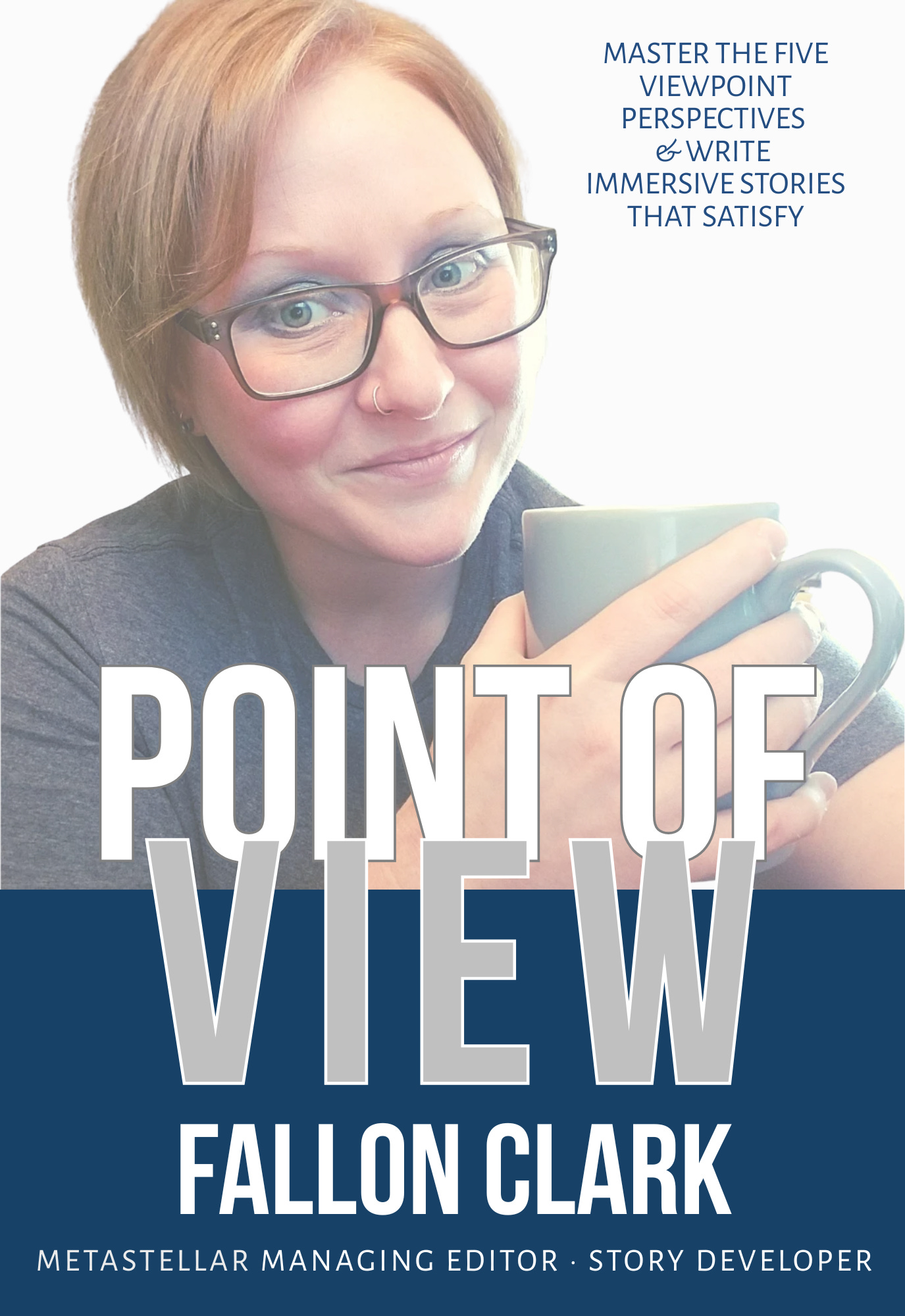
I’m working with MetaStellar Press to republish a micro book focused on choosing and developing the right POV for your story.Here’s a sneak peek at the cover — would you consider buying a book featuring both my face-mug and my coffee-mug? Publishing date: TBD.
Characters:
All the information, mood, and perspective work in the world can’t make a poorly drawn character feel real. To do anything at all for your readers, your characters need to feel alive.
Lisa Poisso for Writers Helping Writers shared her perspective on Breathing Life Into Characters, and the article is worth a read, if for nothing else than to differentiate when to use exposition and when to actually show the character acting out in their environment or situation. It’s that balance of the inner and outer experiences that creates the human effect for your readers.
And remember that your characters — like people — need to relate to each other well, to have some level of intimacy to convince readers that their relationships, romantic or otherwise, are authentic. Trisha Jenn Loehr for Jane Friedman reminds us that Emotional Intimacy Between Characters Isn’t Just For Romance Novels.
Loehr asks you to focus not on romance, but on the other kinds of intimacy — intimacy between friends, neighbors, coworkers, family, mentors — easily overshadowed by romance, especially within the romance genre.
So make sure those BFFs you wrote actually read like best friends.
Plotting:
Plot problems, eh?
Since the plot of the story is often the reason the story exists, plot problems can translate to bored, confused, or frustrated readers fairly quickly. Whether you’re in the early planning stages of your story or are working through revisions on one draft or another, it may be worth your while to confirm certain plot points are present, that your story will check readers’ boxes.
Check out Derek Murphy’s video, The Easiest Way To Plot Your Book. Murphy uses a basic plot structure you can split into four quadrants to focus your efforts on one plot point at a time. And you can use Murphy’s method to reverse-outline your story to pinpoint where the plotting issues may be.
After you’ve solved your problem, finished your manuscript, and are doing those final checks before your story makes its way to the next stop on its publication path, it’s time for you to shift your focus to your next steps:
Preparing your book for readers and finding them!
I’d love to hear from you!
I’d love to hear your thoughts on this article. What resonated? What left questions in your mind or mouth? See something unexpected? Let me know how I can help you meet your writing goals.
Ready for a live or written manuscript evaluation, or an in-depth developmental or language edit on your completed novel manuscript? An author recently sent me this note via email:
“I'm feeling a lot of gratitude for being able to work with you. You clearly understand and value what I'm trying to convey to the world, and your editorial approach has very much brought out the best in me as a writer.”
If you want to discover your best writerly self with an editorial pro who values you and your work, send me a message here or via email (FallonClark@protonmail.com), and let’s get started!
Your story awaits!
Happy writing!
P.S. The second quarterly Novel Nest lit mag featuring short stories and novel excerpts by Novel Nest Writers is on its way! Look for the next edition late December/early January. And don’t forget to join our Saturday night writing sprint tomorrow at 8:30 p.m. ET in The Group on Discord. Cameras and mics off, documents open, creativity on!
P.P.S. I’m trying like hell to show up on video more because that on-call vibe is so SO important for the editor-author relationship. Check out “Why Make Bad Art” here: